
Smithfield Criminal History Checks
Choose the Smithfield source by record type. The Smithfield Police Records FAQ explains how to obtain a police report. The Johnston sheriff's inquiry shows current county jail custody. North Carolina eCourts helps locate a filed Smithfield-related case, and the Clerk of Superior Court provides the official court file. For a certified name-based search of Johnston records, the clerk uses AOC-CR-314. For your own statewide, fingerprint-linked history, use the NCSBI Right to Review process.
Keep the incident number, date, location, and full name before starting. Smithfield police and county court offices are close in physical terms but answer different questions. Use these steps:
- Request the town police report from Smithfield Police Records in person or by mail.
- Check the sheriff's current-inmate inquiry when custody is at issue.
- Search eCourts by name or case number and limit the location to Johnston.
- Verify the docket, order, or judgment with the Johnston clerk.
- Use SBI's fingerprint route when reviewing your own statewide repository record.
Note: A Smithfield report documents police activity, while the Johnston court file establishes the filed charge and its final disposition.
Smithfield Police Records Counter
Smithfield Police Records is at 110 S. 5th Street, Smithfield, NC 27577. The official FAQ says reports may be picked up Monday through Friday from 8 a.m. to 5 p.m. A person who cannot visit may write to Police Records at that address and ask that the report be mailed. Include enough detail to identify the existing record: the report or incident number if known, incident date and location, involved name, requester contact and mailing address, and the specific police report sought.
The official page below is the source for the Smithfield Police request instructions.
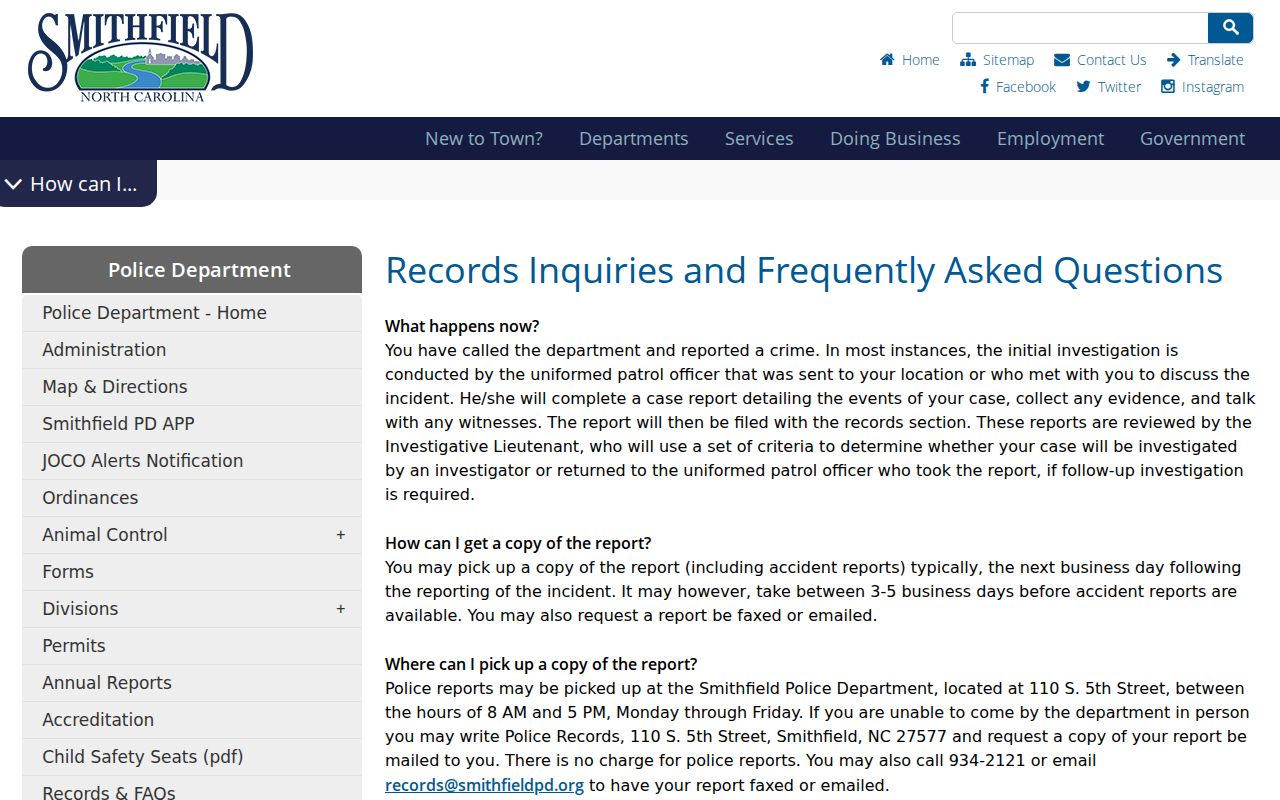
Its court referral is important: Police Records does not certify a full Smithfield criminal court history.
Records at the Smithfield Police Department
Smithfield's police records function reviews report criteria, scans reports and supplemental case material, and submits qualifying data to the SBI. An official 2021 annual report also described public access through a department terminal, email, fax, and pickup. Because that operational source is several years old, ask which electronic channels and any copy fees remain current. The walk-in and mail methods on the current FAQ are the firm routes documented for Smithfield.
A request under Chapter 132 should identify the existing report and preferred format. Police can provide public incident and arrest facts while withholding protected investigative content. Ask for the incident summary if the whole narrative cannot be released. A police report may list an allegation, but it cannot establish whether prosecutors filed the same charge or how the court resolved it.
Mailing Smithfield Police Record Requests
A mailed Smithfield request is useful when the requester cannot reach the weekday counter. Address the request to Police Records, 110 S. 5th Street, Smithfield, NC 27577. State the incident date and location, involved name, report number if known, and a return mailing address. Describe the exact report or public facts requested. Ask staff to quote any current copy or mailing charge because the official FAQ did not state a base fee.
Keep the request narrow. North Carolina agencies must provide access to public records they maintain, but they need not create a new criminal-history compilation. If the purpose is to learn whether a Smithfield case ended in dismissal, conviction, acquittal, or another disposition, direct that part of the request to the Johnston clerk rather than Police Records.
Booking and Arrest Records in Smithfield
A Smithfield arrest can create four related records. Smithfield Police may hold the incident and arrest report. Johnston County Jail may create the booking and current-custody entry. District or Superior Court may hold the case. The SBI may receive a fingerprint-supported arrest cycle and later disposition reporting. Each system serves a separate purpose, and timing differs among them.
The sheriff's active-inmate inquiry is the first online source for current county custody. It can show an arrest date and primary charge, but a released or transferred person may no longer appear. Call 919-989-5010 when the roster is unclear. Then search the court record. A police report cannot supply the final judgment, and a jail label does not prove guilt.
Note: Current custody may end long before a Smithfield police report or Johnston court case reaches its final archival form.
Smithfield Criminal Records Hub
Smithfield's status as the county seat concentrates public records offices in one town. The Johnston County Courthouse stands at 207 E. Johnston Street, Smithfield, NC 27577. It is open weekdays from 8 a.m. to 5 p.m., and the clerk's main number is 919-209-5400. Paper case files, public terminals, certified copies, certified Johnston-only searches, and expunction filings belong there. The clerk, not the police department or central NCAOC office, is custodian of local court cases.
U.S. Census QuickFacts estimated Smithfield at 12,806 residents in 2024, up 13.3 percent from the 2020 estimate base. The town's size and county-seat role make case numbers and agency names useful when several local records share a similar name.
A Smithfield street address alone does not identify the custodian. Check whether the document names Smithfield Police, the Johnston sheriff, a magistrate, or the Clerk of Superior Court before choosing the next office.
The municipal image below comes from the official Town of Smithfield website.
That city identity sits alongside county offices, yet the town and county remain distinct custodians with distinct files.
The Smithfield Municipal Court File
Smithfield does not operate a town-run criminal court portal. North Carolina's General Court of Justice handles state charges. Johnston District Court hears misdemeanors, infractions, and preliminary felony matters. Johnston Superior Court hears felony trials. The Clerk of Superior Court keeps both sets of local case files at the county courthouse.
| Court Name | Johnston County District Court and Superior Court |
|---|---|
| Case Types Heard | Misdemeanors, infractions, preliminary felony matters, and felony trials under the proper division |
| Case Lookup Channel | North Carolina eCourts Portal, public courthouse terminal, or clerk file request |
| What the Docket Shows | Filed charge, case events, status, disposition, judgment, sentence, and public financial data |
| Copies & Fees | Current copy charges through the clerk; $25 for a certified Johnston-only criminal record search |
“Smithfield municipal court record” is therefore a location phrase, not the name of a separate criminal database. Verify state cases through Johnston court channels.
Smithfield Case Records in eCourts
The North Carolina eCourts Portal is the main remote discovery channel for Smithfield-related cases. Search by name or case number, select Johnston as the location, choose the criminal category when offered, and add a filing date range for a common name. Record the case number, charge, filing date, status, and court location. Portal shows case information but may not expose every filed document or restricted item.
The official Johnston court hub is the source for this Smithfield route to county court services and eCourts access.
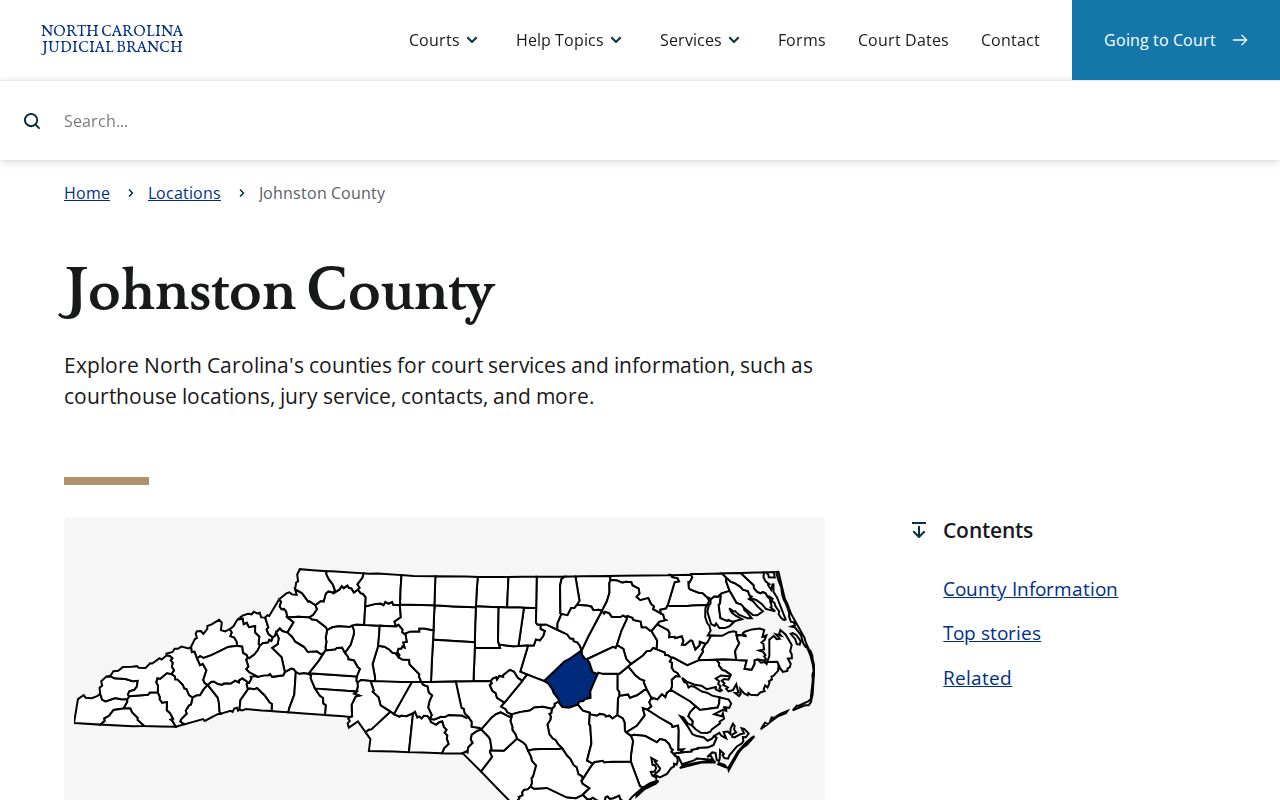
Use the clerk's paper or electronic file when Portal lacks an image or when the exact judgment must be confirmed.
How Smithfield Records Reach the County
Smithfield Police creates its report and sends qualifying information into state systems. A custodial arrest adds the Johnston jail record. A magistrate makes the first probable-cause and release decision, and the clerk creates the court case. Misdemeanors remain in District Court, while qualifying felony prosecutions move to Superior Court. Clerks and agencies then report dispositions into criminal-history systems.
Record flow: Smithfield Police Department › Johnston County Courts › North Carolina State Bureau of Investigation
The route may be short in miles, but the records are not merged. Search Police Records for the report, the sheriff for current custody, the clerk for the case, and SBI for your own fingerprint-based statewide history.
Note: Keep the Smithfield report number beside the Johnston case number so both custodians can trace the same event.
Smithfield Reports, Jail, and Cases
When Smithfield records disagree, first ask whether the sources measure the same stage. A police report records the officer's account and alleged violation. A jail entry reports custody and a primary charge at that point. A case file tracks the filed allegations and the court's result. The SBI record organizes identity-linked arrest cycles and reported outcomes.
| Source | Question answered | Best verification |
|---|---|---|
| Smithfield Police | What report did the town agency create? | Report number, date, place, involved name |
| Johnston jail | Is the person now in county custody? | Call 919-989-5010 if the active list is unclear |
| Johnston clerk | What was filed and how was it resolved? | Case number and official judgment |
A “disposed” case is complete, but that term does not mean convicted. Read the charge-level outcome in the court file.
Smithfield Court Record Access
Visitors can use the courthouse's public terminal without a search fee, though printing may cost extra. The clerk can provide the paper or electronic case file when an online image is missing. The building's wheelchair entrance is on Second Street, with the ramp mid-block. Current signs and staff instructions control access. The courthouse also publishes separate criminal, DWI, domestic violence, probation, disposition, and bond-forfeiture calendars, so verify the calendar rather than assuming one general session.
A Smithfield terminal search can cover county or statewide NCAOC court data, but a Smithfield paper-file request should use the exact Johnston case number. The terminal helps when Portal lacks an image or a name search returns several people. Note the Smithfield court division as well. District Court and Superior Court belong to the same Johnston system, yet they handle different stages and levels of criminal cases. Ask the Smithfield clerk counter for the filed judgment when an online status does not show the precise charge-level result.
Smithfield also posts local calendars for DWI, criminal domestic violence, disposition, probation, and bond matters. A calendar shows when a matter is set, not how it ended. Match the Smithfield case number to the docket and later judgment.
A certified Johnston-only name search costs $25 and uses AOC-CR-314. Mail payment accepts a money order or certified check, not a personal check. In-person payment accepts cash, credit card, money order, or certified check. The result is not a statewide SBI search.
Smithfield Record Access Rules
Chapter 132 governs access to existing Smithfield public records. It allows inspection and copies at reasonable times, permits reasonable copy charges, and does not require the town to create a compilation it does not keep. G.S. 132-1.4 generally protects criminal investigative and intelligence material while identifying public incident and arrest facts. A narrow request for an incident date, location, nature, arrested person's basic listed data, alleged violation, and arrest circumstances is different from a demand for the full investigative file.
For a Smithfield report, send the request to Smithfield Police and name the event. For a Smithfield criminal case, use the Johnston clerk and case number. The NCAOC public-record request form is for Judicial Branch administrative records, not local Smithfield case files or criminal background searches. This custodian split prevents delay. It also keeps the Smithfield police narrative, Johnston court disposition, and any SBI criminal-history cycle in their proper systems.
Key Statutes:
North Carolina Public Records Law governs inspection and copies of existing town records.
G.S. 132-1.4 defines public arrest and incident facts while protecting investigative material.
Chapter 15A, Article 5 controls eligible expunctions and the resulting limits on public access.
Juvenile files, sealed matters, expunged records, protected victim or witness details, and sensitive investigative content may remain unavailable. Ask the right custodian for the public portion.
Note: Smithfield Police may charge reasonable copy costs, but no current uniform report fee appeared in the official sources reviewed.