
Clayton Criminal History Checks
Begin a Clayton criminal record search by deciding whether the need is for a police report, a current booking, a filed court case, or a subject's own statewide history. Those are separate records. The Clayton Police Administrative Division keeps department reports and supporting material. The Johnston County Sheriff provides the current jail inquiry. The Clerk of Superior Court and North Carolina eCourts hold the court case. The North Carolina State Bureau of Investigation, or NCSBI, provides the fingerprint-based Right to Review for a person's own statewide repository record.
A useful Clayton check follows the event from its source. Names alone can produce a poor match in this fast-growing town. Keep the report number, case number, event date, and exact location when they are known. A five-part search keeps the source and scope clear:
- Ask Clayton Police for the incident, crash, or public arrest information created by its officers.
- Give the event date, place, involved-party name, and report number when available.
- Check the Johnston sheriff inquiry for current custody and the primary charge.
- Search North Carolina eCourts with the Johnston location filter, then verify the file with the clerk.
- Use an NCSBI Right to Review when checking your own fingerprint-linked statewide history.
Note: A Clayton police report, jail listing, court file, and SBI history answer different questions and should be compared with care.
Clayton Police Records Section
Clayton places Records within the Police Administrative Division. Its duties are unusually broad. Staff receive, file, and recall department reports, maintain master index files, supply supporting documents, prepare activity reports, and administer computerized record programs. The unit also keeps permitting records, supports crime analysis, and enters or maintains Johnston County 911 data for department and public use. This local role makes Police Records the best first stop for a report written by a Clayton officer, but it does not turn the unit into a court-history repository.
The official Administrative Division page provides a direct view of the Clayton records function. The image below comes from the town's Police Administrative Division.
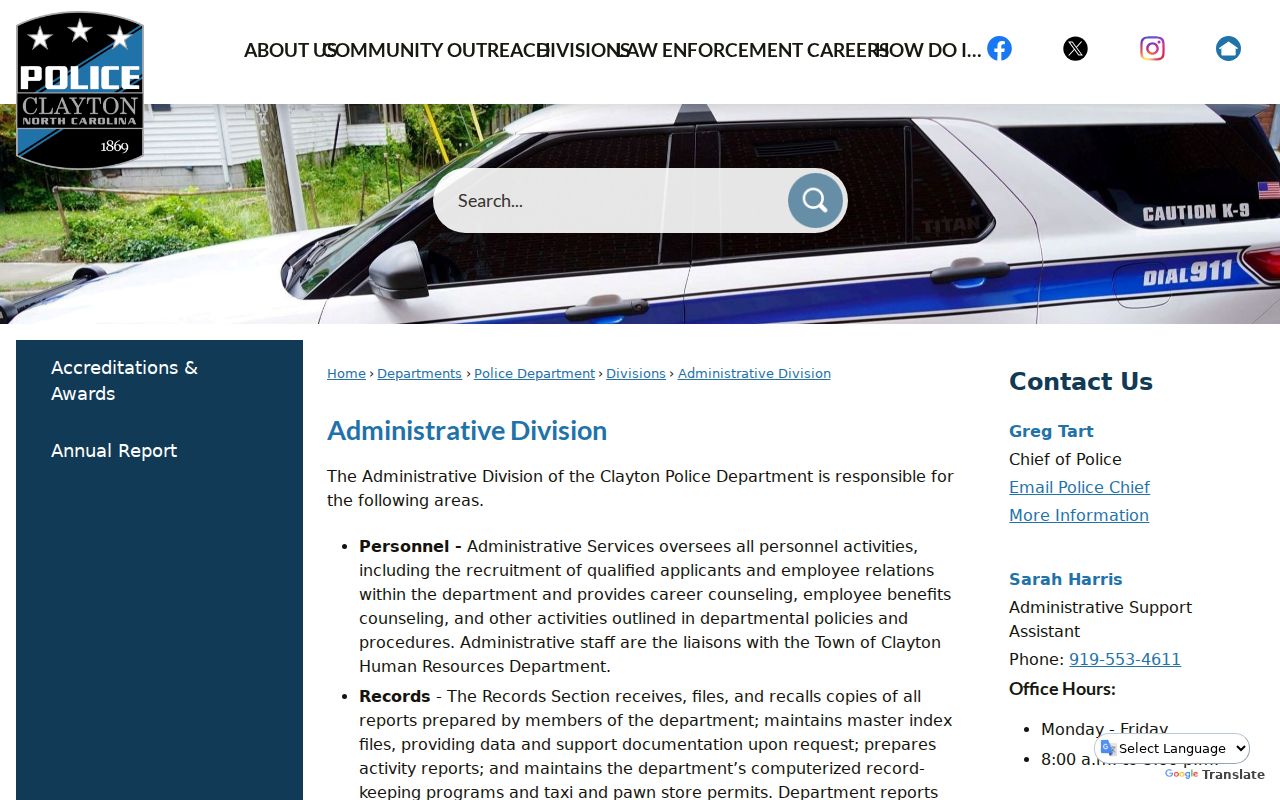
That page confirms why a local report request belongs with Clayton Police before a search moves to the county clerk.
Records at the Clayton Police Department
A precise request helps Clayton Police locate an existing record without asking staff to create a new summary. Include the requester's name and contact details, the incident or report number, event date and time, location, involved-party name, and the exact record sought. State whether the request concerns an incident report, crash report, or public arrest facts. Add the preferred delivery method and ask whether certification is available if a certified copy is needed. The official research did not locate a fixed Clayton form fee, so request a current estimate rather than assuming a price.
Clayton's police FAQ makes a key distinction between reports and criminal-history searches. The official Clayton police FAQ directs criminal-record requests to the Johnston County Courthouse and Clerk of Superior Court.
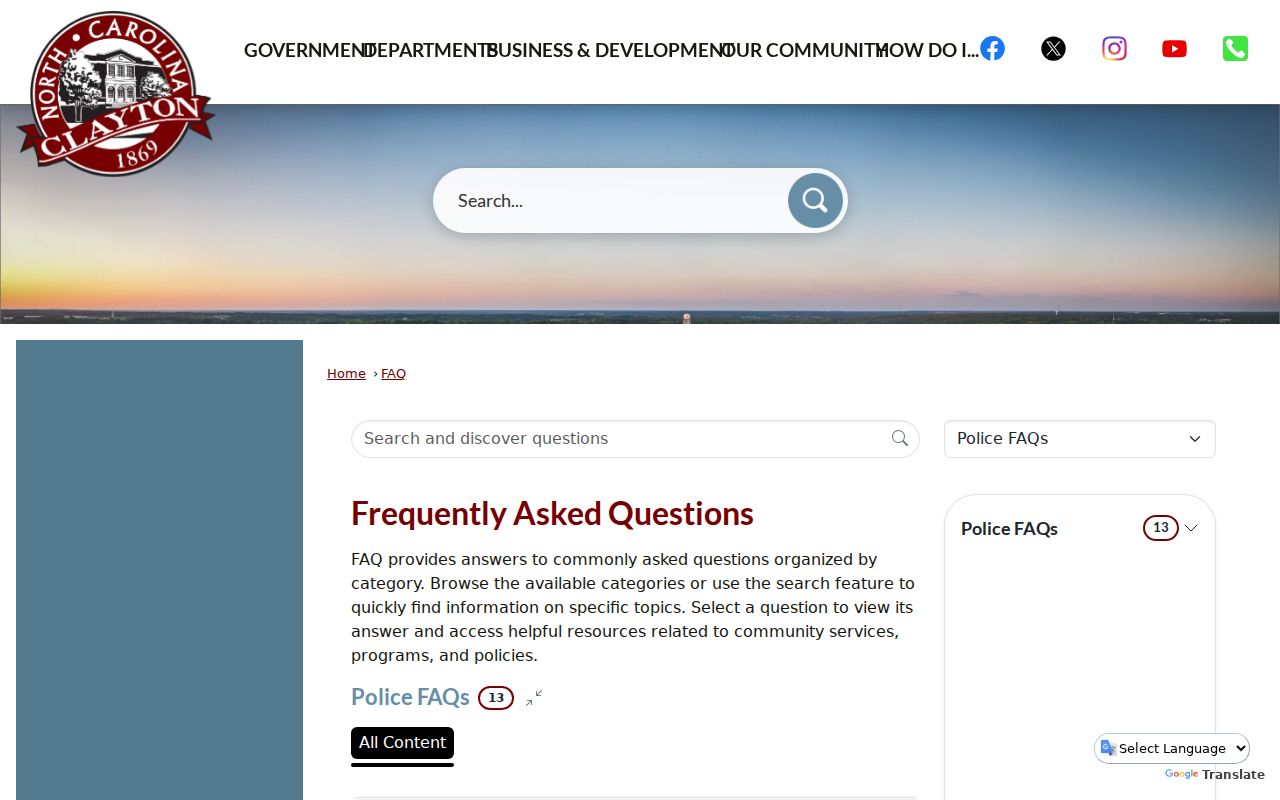
The routing shown there keeps an officer's report separate from the filed charges, judgment, and disposition held by the clerk.
Clayton Records Route to Smithfield
Clayton does not keep a separate felony or misdemeanor court database. A request for town police material stays with Clayton Police, but a request for criminal court history moves to Smithfield. The Johnston County Courthouse is at 207 E. Johnston Street, Smithfield, NC 27577. The clerk's main number is 919-209-5400, and the counter operates on weekdays from 8 a.m. to 5 p.m. The clerk provides case-file inspection, public terminals, certified copies, and the certified Johnston-only name search.
Online discovery is available through the North Carolina eCourts Portal. Select Johnston as the location and use a name or case number, with criminal category and filing dates when those filters appear. Portal is not the state's certified background-check product. A certified Johnston County search uses form AOC-CR-314 and costs $25. It remains a one-county, name-based search, not a fingerprint-backed statewide SBI record.
Booking and Arrest Records in Clayton
A custodial Clayton arrest ordinarily moves to the Johnston County Jail. Clayton Police creates the incident and arrest material, while jail staff create the booking and custody record. The sheriff's public inquiry is a current-inmate tool. It can show a name, arrest date, primary charge, and current housing status, but it is not a lasting Clayton arrest archive. A person may disappear from the list after release or transfer even though the police report and court case still exist.
If a name is absent, call the jail information line at 919-989-5010, confirm the arresting agency, and check eCourts for a filed Johnston case. The county-level Johnston arrest search explains the full booking and agency chain. For a Clayton-specific report, return to Clayton Police. For an outcome such as dismissal, conviction, or acquittal, use the clerk's case file.
Note: The sheriff's “primary charge” label is a custody summary, not a complete list of filed counts or proof of guilt.
Missing Clayton Booking Records
A missing name on the active jail list does not settle whether a Clayton arrest occurred. The person may have posted bond, been released, transferred, or entered state custody. Start with the arrest date and agency. Ask Clayton Police for public arrest facts or the applicable report. Call the sheriff when current or recent custody is unclear. Then search eCourts using the Johnston filter and a date range. Case filing can lag behind the arrest, and a common name may need a case number or exact date to distinguish the right person.
When a sentence leads to state prison, probation, parole, or post-release supervision, the NCDAC Offender Public Information Search becomes the relevant custody or supervision source. NCDAC data does not replace the Clayton report or Johnston judgment. It adds the later state status.
The Clayton Municipal Court File
North Carolina towns do not operate the separate municipal criminal courts found in some other states. Clayton therefore has no town criminal docket for felony, misdemeanor, or infraction cases. Johnston District Court handles misdemeanors, infractions, and preliminary felony matters. Johnston Superior Court handles felony trials. Both operate through the General Court of Justice and the Clerk of Superior Court, not a Clayton municipal clerk.
| Court Name | Johnston County District Court and Superior Court |
|---|---|
| Case Types Heard | District Court hears misdemeanors, infractions, and preliminary felony matters; Superior Court hears felony trials. |
| Case Lookup Channel | North Carolina eCourts Portal, courthouse public terminal, or Clerk of Superior Court file request |
| What the Docket Shows | Case number, filing date, charge, events, status, disposition, judgment, and sentence when public |
| Copies & Fees | Ask the clerk for current copy charges; a certified Johnston-only search costs $25. |
This structure matters because the words “Clayton criminal court” describe where conduct began, not a separate town-run file system.
Clayton Record Search Identifiers
U.S. Census QuickFacts estimated Clayton at 31,732 residents on July 1, 2024, up 20.6 percent from the 2020 estimate base. Growth raises the odds that a name-only search will return several possible records. Use the full name and middle name where lawfully displayed, then compare the case number, event or filing date, charge, and Johnston location. Do not rely on a matching name by itself.
Clayton search results also need a date check. A recent Clayton incident may still be only a police or jail record, while an older Clayton matter may have a court disposition and no active custody entry. When two Clayton names look alike, use the agency, report number, and case number as the bridge. Those identifiers are more reliable than a loose name match.
The town's official visual comes from the Town of Clayton website.

It anchors the city identity behind a records system that still routes criminal court cases to the county seat.
How Clayton Records Reach the County
A Clayton incident begins with the agency response. Police retain the report. If an arrest occurs, Johnston jail creates a booking entry and captures the custody data. A magistrate makes the first probable-cause and release decision. The clerk then creates the District Court case, and a felony may move into Superior Court through the proper charging process. Court outcomes are reported into state criminal-information systems.
Record flow: Clayton Police Department › Johnston County Courts › North Carolina State Bureau of Investigation
Recent activity may appear first in police or jail files. A later Clayton case outcome belongs in the court record. The SBI rap sheet is identity-oriented and may group fingerprint-supported arrest cycles with reported dispositions. None of those sources substitutes for the others.
Note: A Clayton case number is the safest link between an eCourts result and the official Johnston clerk file.
Clayton Criminal Records at The Station
Clayton's restored building known as The Station gives the town a real police-and-court records timeline. Built in 1925, it once housed municipal offices, police, fire, the library, and a courtroom. That shared civic space reflects an earlier era when town functions sat under one roof. The modern system is split: Clayton Police keeps department reports, Johnston County courts keep criminal cases, and state agencies keep repository or correctional records.
The town reported recognition for the restoration in 2025. The history is more than a landmark detail. It explains why an old reference to a Clayton courtroom should not be read as proof that a current municipal criminal court database exists. Present-day searches must follow today's custodians.
That shift also helps with older Clayton references. A document naming the former shared station may describe a town office that has since moved or changed roles. Use its date and record type to identify the present custodian. Modern police reports go to Clayton Police Records, while a state criminal case number still leads to the Johnston clerk in Smithfield.
Clayton Reports and Court Records
A police report describes what officers recorded about an event. A court file shows the allegations formally filed and how the court resolved them. The jail inquiry answers current custody. Confusing those sources can turn an accusation into an assumed conviction or hide a dismissal that appears only in the court disposition.
| Clayton source | Best use | Main limit |
|---|---|---|
| Police Records | Incident, crash, report, and public arrest facts | Does not supply the final court outcome |
| Johnston jail inquiry | Current custody, arrest date, primary charge | People leave the active list after release or transfer |
| eCourts and clerk | Filed charge, hearings, disposition, judgment | Restricted and expunged material is not public |
For the most reliable result, compare matching identifiers and obtain the official file from the office that created it.
Clayton Record Access Rules
The North Carolina Public Records Law applies to existing Clayton government records, but it does not make every police file public. Chapter 132 permits inspection and copies at reasonable times. It also allows reasonable copy costs and says an agency need not create a compilation it does not maintain. Criminal investigative and intelligence records are generally nonpublic, while the law identifies specific incident and arrest facts that agencies must treat as public.
Key Statutes:
G.S. Chapter 132 sets North Carolina's public-record inspection and copy rules.
G.S. 132-1.4 separates public incident and arrest facts from protected investigative material.
Chapter 15A, Article 5 governs eligible North Carolina expunctions and restricted access after relief.
Ask for the incident summary or named public facts when a full narrative cannot be released. Victim and witness identifiers, juvenile information, sealed material, and expunged records can remain restricted.
Note: Clayton may charge reasonable copy costs, but the official sources reviewed did not publish one fixed police-report fee.