
Criminal Court Cases in Johnston County
Johnston County criminal court cases run through North Carolina's General Court of Justice, but the file can move between court levels. District Court handles misdemeanors, infractions, and the early stages of felony matters. A felony that proceeds by indictment moves to Superior Court for arraignment, pretrial work, plea or trial, and judgment. Criminal magistrates issue process and make initial probable-cause and release decisions. The District Attorney prosecutes the charge, yet neither office is the custodian of the full court file.
The Johnston County court hub identifies three overlapping maps: Prosecutorial District 13, Superior Court District 13, and District Court District 12. That does not mean three separate case databases exist. The official elected roster identifies Clerk Michelle Ball, whose office keeps the Johnston County files under each case number. The official contact directory lists 919-209-5400 for the clerk, 919-209-5510 for Superior Court judges, 919-209-5452 for District Court judges, and 919-209-5462 for criminal magistrates.
Johnston County Court Case Levels
The charge and procedural stage tell a reader which Johnston County court case record to inspect. A misdemeanor can be heard and resolved in District Court. A felony may start there for an initial appearance and preliminary work, then continue in Superior Court after a proper charging step. North Carolina's official punishment and classification statutes explain why the offense class shown on a docket is not itself the final sentence. Benson sessions also appear on current local schedules for selected District Court matters, so the case event location should be checked rather than guessed.
| Court or function | Typical role | Record source |
|---|---|---|
| Superior Court | Felony trials, pleas, judgments, and sentences | Clerk file and eCourts docket |
| District Court | Misdemeanors, infractions, and felony preliminary stages | Clerk file and eCourts docket |
| Criminal magistrate | Process, probable cause, and initial release conditions | Related process and court file |
| Benson session | Selected District Court settings on the local calendar | Current calendar and clerk confirmation |
These roles explain why a Johnston County felony search can show District Court events before Superior Court activity. Follow the same Johnston County case and charge, and confirm the location listed for each hearing.
Johnston County Case Record Searches
Start with the North Carolina eCourts Portal for free Johnston County case discovery. An exact case number is the safest key. A name search can work, but common names need a Johnston County filter, a criminal category, and a filed-date range. The portal may show the docket while withholding a document image, so it is the index and access point rather than a promise that every filed page is online.
- Open eCourts Portal and select the public records or Smart Search mode shown on the live screen.
- Enter the exact case number when known. Otherwise, search the party name with careful spelling.
- Apply Johnston County, criminal case, and date filters to separate similar names and unrelated files.
- Open the case details. Record each charge, event, status, disposition, and court location on its own terms.
- Call or visit the clerk for the charging paper, judgment, certified copy, or older file that Portal does not display.
| Field or control | Type | Required | Use in a Johnston search |
|---|---|---|---|
| Search type or tab | Tab or dropdown | Yes | Choose the public Smart Search or records mode offered |
| Search criteria | Text | Yes | Enter a name or case number in the format shown |
| Advanced filtering | Control | No | Open added filters for a broad result set |
| Location or county | Dropdown | Recommended | Select Johnston County |
| Case category or type | Filter | No | Choose criminal when available |
| Filed date range | Date range | No | Narrow common names or a known filing period |
| Party or attorney | Search mode | No | Switch search modes when those facts are known |
| Search and Reset | Buttons | As needed | Run the query or clear filters |
Johnston County eCourts Case Portal
Johnston County joined the first Odyssey pilot group on February 13, 2023. North Carolina finished moving all 100 counties to Enterprise Justice by October 13, 2025. The longer local transition helps explain why an older Johnston County court case may have metadata online without every paper or image a reader expects. Search mode names and filter labels can also change as the system is updated.
The official eCourts program page is the source for current portal access and rollout notices. The captured portal view shows the public landing interface used for case discovery.
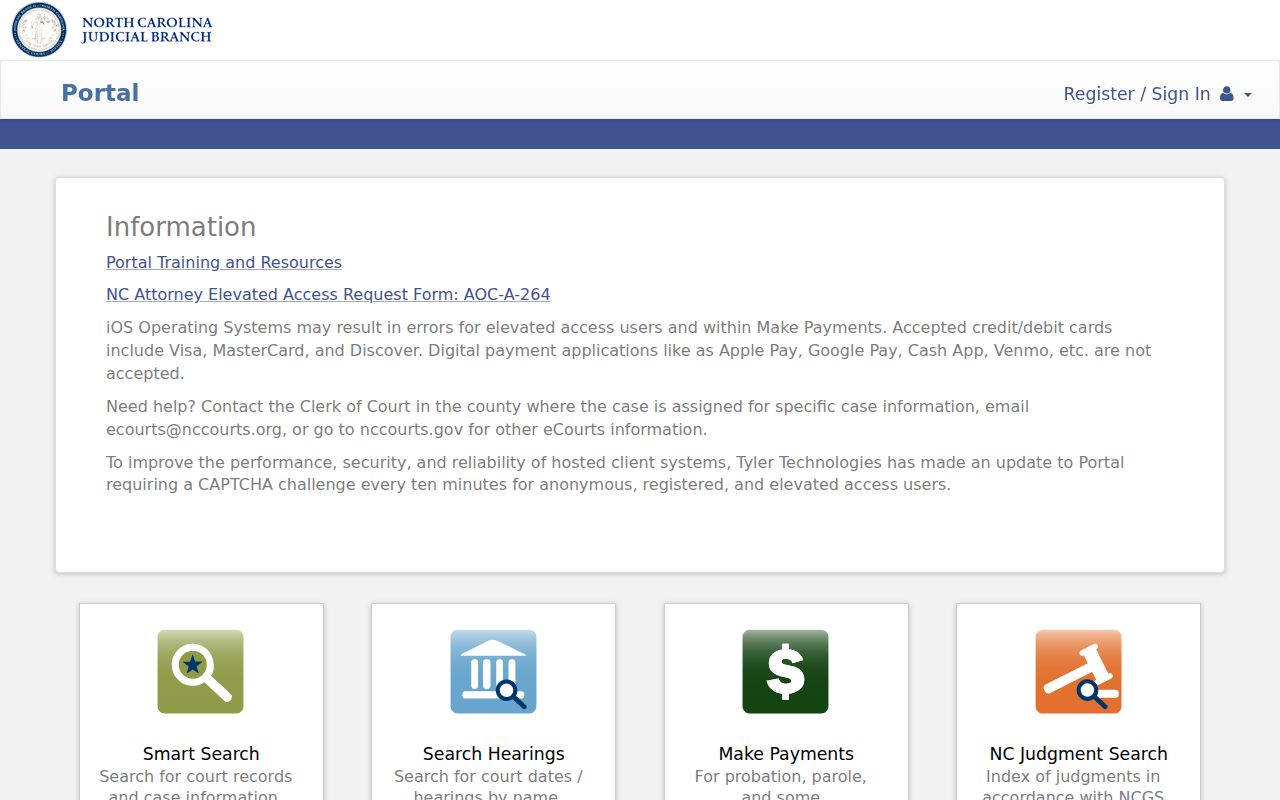
Use the live interface for current results, then save the case number before asking the Johnston County clerk for a filed order or judgment.
Note: Portal case information is not the Judicial Branch's certified criminal-background-check product and may omit restricted records or document images.
What a Criminal Case File Contains
A Johnston County criminal case file is organized around a court number, not an arrest cycle. It can connect the initial process to appearances, motions, scheduled events, rulings, and the final Johnston County case outcome. Each charge needs separate review because one file may contain a conviction on one count and a dismissal or other result on another. The court's judgment is stronger evidence of the result than a jail roster's primary-charge label.
| Case number and court | County, case category, file date, status, location, and assigned judicial officer when public. |
|---|---|
| Charging document | Citation, criminal process, information where allowed, or indictment that states the operative allegation. |
| Party and charge data | Public party role, charge description, statute, class, offense date, agency, and attorney information. |
| Docket entries | Filed events, motions, orders, and the document register, though every image may not be online. |
| Hearing dates | Event date, time, type, and location, which should be checked against the local calendar. |
| Disposition and judgment | Outcome and disposition date for each charge, including dismissal, acquittal, plea, or verdict where public. |
| Sentence and financial data | Public sentence terms, judgment details, balance, and payment eligibility when the case view exposes them. |
Juvenile, expunged, sealed, and other confidential details do not appear like an ordinary public Johnston County court case. Limited demographics and protected victim or witness information may also be redacted.
Reading Johnston County Case Outcomes
A status of “disposed” means the court completed a disposition. It does not mean “convicted.” The result could be a guilty plea, verdict, dismissal, acquittal, or another lawful outcome. “Pending” means the matter is not resolved in the court record. A nolle prosequi is the prosecutor's formal choice not to proceed at that time, while an acquittal is a not-guilty finding. A sentence follows a conviction and states the punishment or conditions imposed.
- Disposition
- The outcome that resolves a charge, not a synonym for conviction.
- Nolle prosequi
- A prosecutor's formal decision not to proceed with the charge at that time.
- Acquittal
- A court or jury determination of not guilty.
- Judgment
- The court's formal ruling, including conviction and sentence details when applicable.
- Expunction
- North Carolina's process for removing, sealing, or destroying eligible official criminal records.
Read each Johnston County charge row and its matching Johnston County judgment. A top-level case status can hide mixed outcomes that matter to an accurate understanding.
Criminal Case Stages in Johnston County
A Johnston County criminal case may begin with an arrest, citation, or summons. A magistrate handles initial process and release matters. District Court then hears misdemeanors and felony preliminary stages. If a felony proceeds by indictment, Superior Court takes the later arraignment, pretrial, plea or trial, judgment, and sentence. Appeals may add later entries where the law allows.
Case flow: Charges Filed › Arraignment › Pretrial › Plea or Trial › Disposition › Sentencing
The Johnston County flow is a reading aid, not a fixed schedule. Some charges end before trial, and one case can return for a probation issue or other post-judgment event. For the arrest and booking trail that precedes filing, use the county's Johnston County arrest search alongside the court file.
Johnston County Criminal Case Calendars
Johnston County does not place every criminal matter on one generic calendar. The Judicial Branch publishes separate local links for DWI, criminal domestic violence, disposition, probation cause, probation violation, bond forfeiture, and Benson court dates. A docket event should be matched to the current schedule because court type, session, and location can differ.
The official Johnston County administrative schedules page provides the named calendar routes.
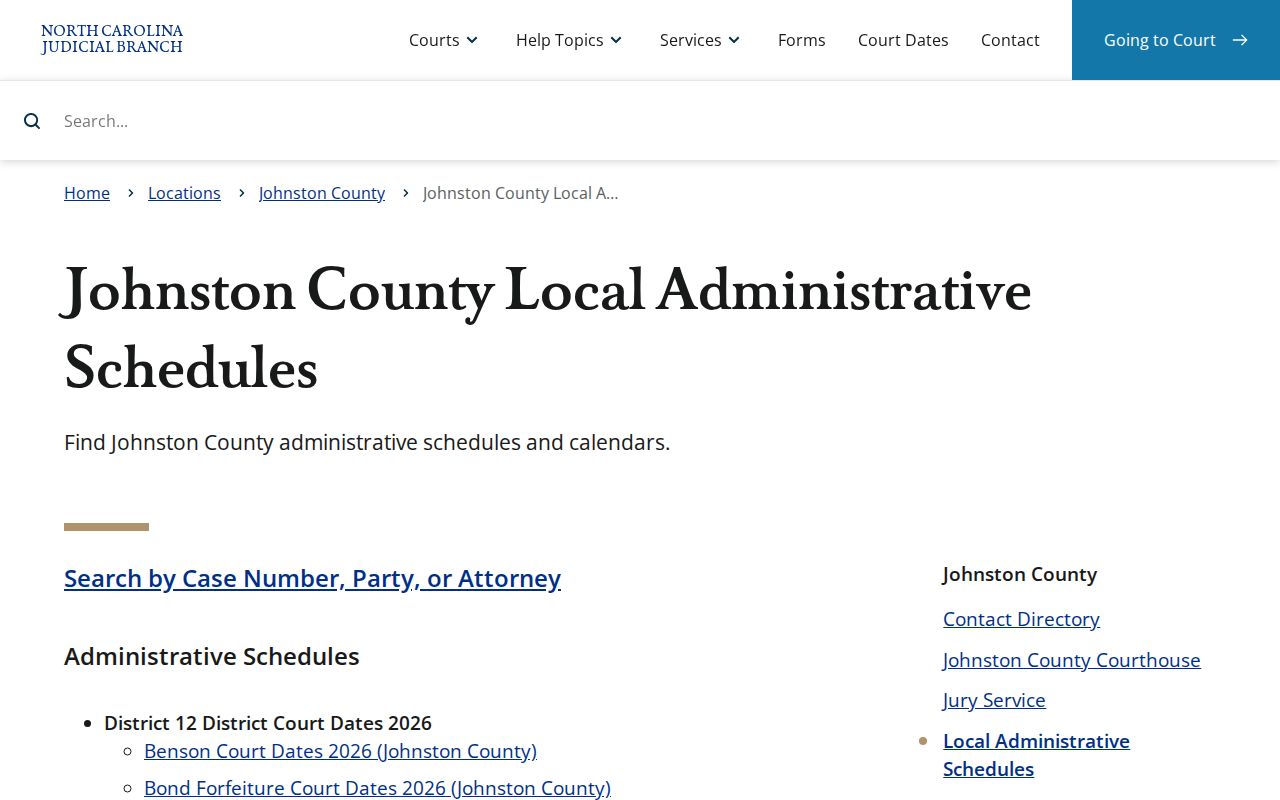
This schedule screen helps a reader distinguish a routine criminal setting from a DWI, probation, or bond-forfeiture session before contacting the clerk.
A 2025 Governor's Highway Safety Program grant totaled $147,000 for work to speed DWI cases in Johnston, Mecklenburg, and Wake counties. That initiative may affect Johnston County case movement, but it does not replace the date and event shown in an individual Johnston County court file.
Access Rules for Case Records
North Carolina law supports public inspection of court records under clerk supervision. G.S. 7A-109 governs court-record inspection and copies, subject to other restrictions. The broader G.S. 132-1 defines public records, but the clerk remains the right custodian for an actual Johnston County case file. The central NCAOC public-record request form expressly does not produce case files or criminal background searches.
Juvenile matters, expunged cases, sealed proceedings, protected identifiers, and some victim or witness information can be withheld or redacted. A blank Portal result does not prove no proceeding exists. It may reflect spelling, a different county, an older paper record, a recent filing, or a lawful access limit. Search the courthouse terminal, then ask the clerk to check a known case number or year. The NCAOC administrative-record request page confirms that its form is not a substitute for asking the clerk for a case file.
Get Johnston County Case Judgments
For a judgment, charging paper, certified copy, or older archive, contact the clerk rather than the sheriff or the state administrative office. The Johnston County Courthouse is at 207 E. Johnston Street, Smithfield, NC 27577. The clerk is open weekdays from 8:00 a.m. to 5:00 p.m.; mail goes to PO Box 297, Smithfield, NC 27577. Bring or state the case number and year whenever possible.
Clerk of Superior Court
207 E. Johnston St.
Smithfield, NC 27577
Mail: PO Box 297
919-209-5400
Monday-Friday, 8:00 a.m.-5:00 p.m.
The official court-record access instructions explain free public terminals and Johnston County paper-file inspection. The separate Johnston County jury guidance confirms that public court operations also use the courthouse annex.
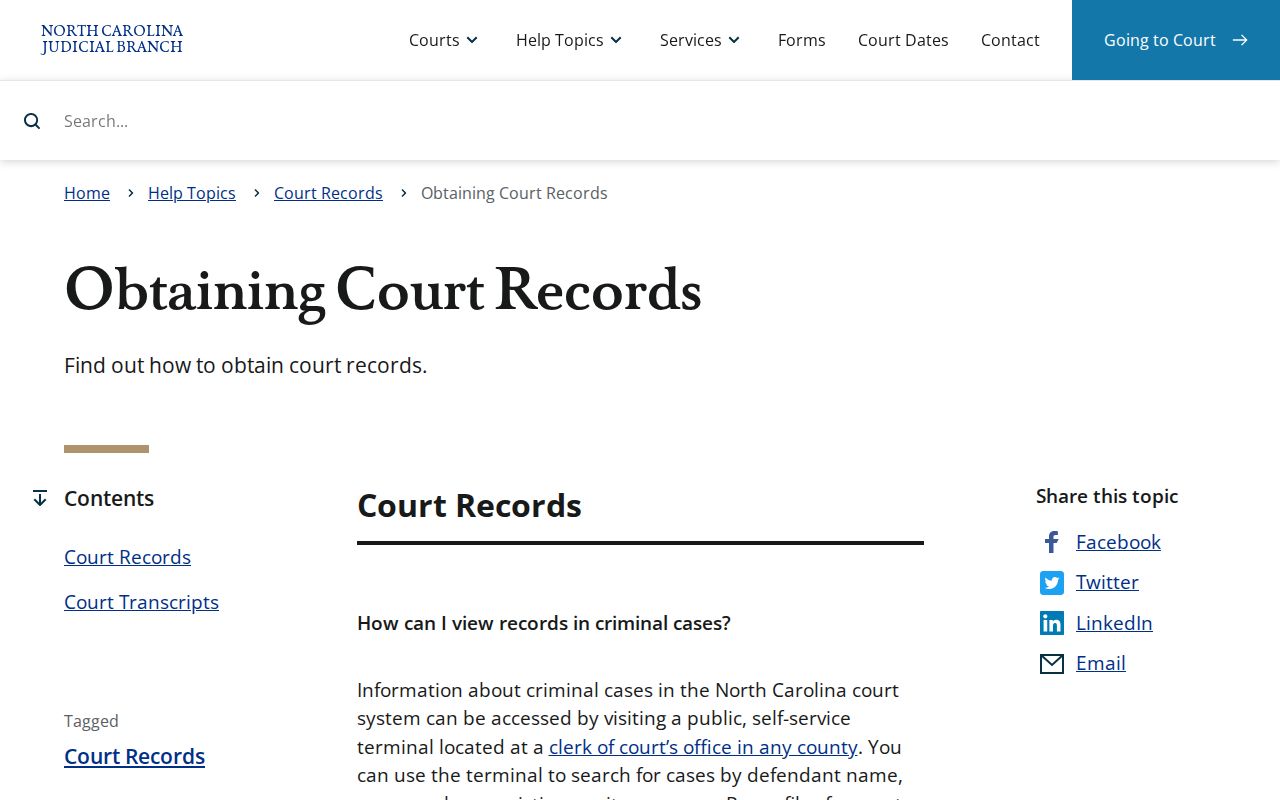
The access page confirms why the terminal, the online docket, and the clerk's paper or electronic file can expose different layers of the same case.
A certified name-based Johnston County search uses form AOC-CR-314 and costs $25. Mail payment accepts a money order or certified check, not a personal check. In-person payment accepts cash, card, money order, or certified check; the local payment page supplies current court-payment channels. The Judicial Branch's criminal background check comparison confirms that this product covers Johnston County court records only. It is not a statewide SBI history.